Philips DCG10/15
1930
see more
![objecto]()
![objecto]()

+
-
© Cláudia Damas
+
-
How do you felt?
-
2 Happy -
3 Astonished -
0 Sadness -
3 Laughter
Philips DCG10/15
1930
-
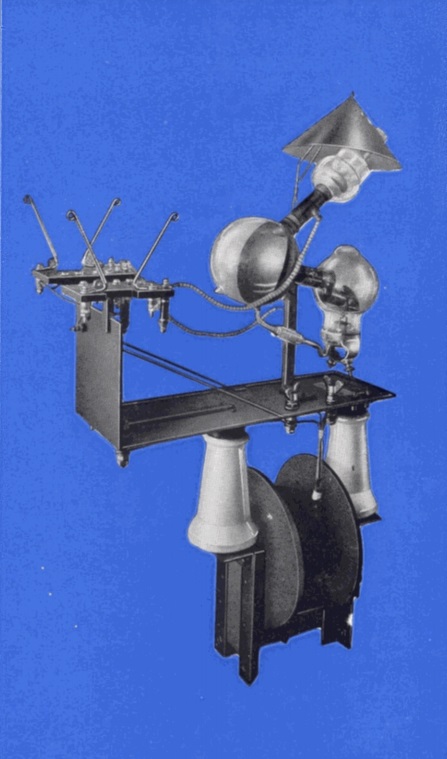
The Philips DCG10 / 15 is a mercury rectifier valve, four phase, voltage of 10000 V DC, (formerly known as 1767), which had an oxide filament that had the advantage of producing a high emission of electrons and having a low heating energy consumption.
The valve consists of three spherical parts, joined by chromed iron tubes, used as auxiliary anodes. The valve could be mounted on a Philips type 4123 tripod.
The Tripod had a transformer for the heating voltage, as well as for auxiliary voltages to the chrome iron connections. The mica cap on the anode was used to concentrate the heat.
One of the spherical parts served as a condenser to prevent mercury from settling on the anode. The higher DC voltage output of this valve depended on the maximum allowable AC voltage from the anode that could be applied to the circuit.
In 1891, Gerard and Anton Philips founded Philips, in Eindhoven (Netherlands).
The company was initially dedicated to the manufacture and commercialization of carbon filament incandescent lamps, evolving towards the development and manufacture of a variety of electronic products, namely in X-ray and broadcasting technology (first television experiences in 1925 radio repair and production in 1927).
Philips followed and contributed to technological evolution over time, having manufactured the first audio cassette player (1963), the first portable radio receiver with cassette recorder (the boom box) (1966), the first video recorder (VCR) (1971) and the first LaserDisc (1978).
In 1965, the first Philips brand transistor equipment is manufactured.
Also in 1930
- 30 of July - In Montevideo, Uruguay wins the first FIFA World Cup.
- 6 of March - International Unemployment Day demonstrations globally initiated by the Comintern
- 9 of June - A Chicago Tribune reporter, Jake Lingle, is killed during rush hour at the Illinois Central train station by Leo Vincent Brothers, allegedly over a $100,000 gambling debt owed to Al Capone.
Stewart Warner 97-573
1939 - Radio Receiver
see more
Stromberg-Carlson 180L
1936 - Radio Receiver
see more
Studer Revox D730
Audio Player
see more
Studer Revox B62
1972 - Tape Recorders
see more
Studer Revox PR99 MKIII
1985 - Tape Recorders
see more
Studer Revox PR99
1985 - Tape Recorders
see more
Studer Revox A727
1987 - Audio Player
see more
Studer Revox A730
1988 - Audio Player
see more
Studer Revox C221
1991 - Audio Player
see more
Supersonic Conqueror P.R. Hi Fi 127
1980 - Radio Receiver
see more
Tandberg Bandopptaker 2
1954 - Tape Recorders
see more
Tandberg Model 6
1963 - Tape Recorders
see more